Frequently Asked Questions About Sewage Backup Cleanup
What is included in professional sewage backup cleanup?
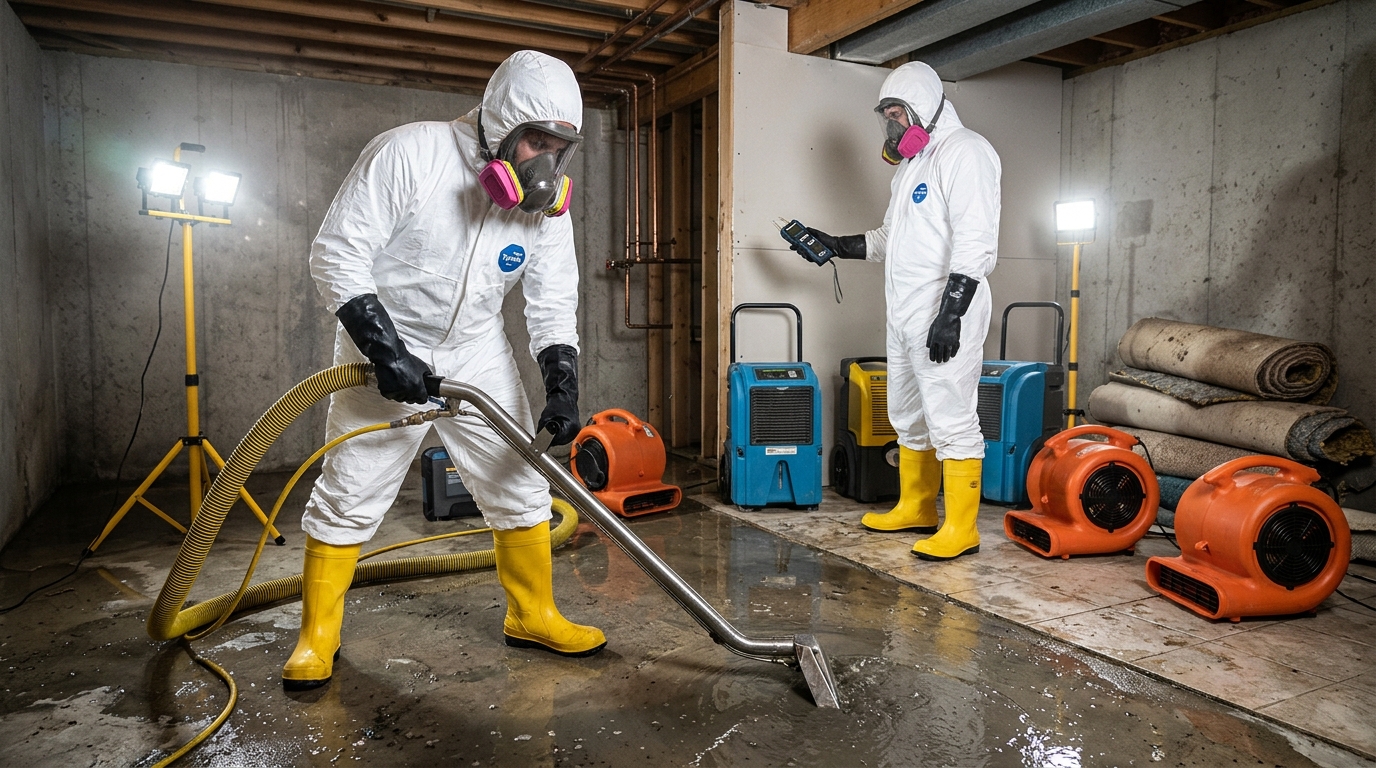
Professional sewage cleanup covers the comprehensive indoor remediation of Category 3 black water: confirming whether wastewater is still entering, physically isolating wet rooms with plastic barriers, extracting standing sewage and sludge, removing unsalvageable porous building materials (such as carpet padding, drywall, and insulation), washing surfaces to remove biofilms, applying EPA-registered hospital-grade biocides strictly according to label dwell times, and psychrometric structural drying with commercial dehumidifiers and air movers until calibrated moisture meters confirm framing is dry. It does not include clearing or snaking the private sewer pipe, repairing municipal sewer mains, or cosmetic rebuilding (such as hanging new drywall or installing finished flooring) unless those trades are quoted on separate contracts.
Why is sewage classified as Category 3 black water?
Under the ANSI/IICRC S500 Standard for Professional Water Damage Restoration, Category 3 black water is grossly contaminated water containing pathogenic bio-agents, bacteria (such as E. coli and Salmonella), viruses, parasitic cysts, chemical toxins, and heavy metals. Wastewater overflowing from a drain, toilet past the trap, or sewer main poses severe health hazards through skin contact, open wounds, accidental ingestion, and the inhalation of aerosolized pathogens and sewer gases. Category 3 losses require specialized containment, personal protective equipment (PPE), and controlled demolition.
Can I clean up raw sewage myself using household bleach?
No. Household bleach should never be used on standing raw sewage. First, organic matter in sewage rapidly consumes and neutralizes the active chlorine in bleach, rendering it ineffective as a disinfectant. Second, mixing chlorine bleach with the ammonia compounds present in raw sewage generates toxic chloramine gas, which causes severe respiratory tract damage. Third, bleach cannot penetrate porous carpet padding, wood subfloors, or gypsum wallboard where bacteria thrive. Proper remediation requires the physical extraction of sewage, the disposal of saturated porous goods, and the application of EPA-registered hospital-grade biocides to cleaned structural framing.
Does homeowners insurance cover sewage backup cleanup?
Standard homeowners policies (HO-3 forms) almost universally exclude sewer and drain backups unless an optional Water Backup and Sump Overflow Endorsement (often designated as endorsement HO-0442) was added to the policy prior to the loss. These endorsements typically provide specific coverage limits ranging between $5,000 and $25,000, subject to a dedicated deductible. Overland flooding caused by rising rivers or outdoor storm runoff requires a separate National Flood Insurance Program (NFIP) flood policy. Review your policy declarations page immediately or contact your insurance agent to confirm your endorsement limits. Sewage Backup Cleanup Pros provides itemized moisture logs, photographs, and disposal inventories to support your claim file.
How much does professional sewage backup cleanup typically cost?
There is no honest flat fee for sewage cleanup because costs are determined by physical site variables: square footage of the affected zone, depth of standing wastewater, hours the sewage remained stagnant, volume of saturated drywall and flooring requiring removal, hazardous debris hauling, and the number of drying days verified by moisture meters. Published national contractor planning averages frequently place residential sewage mitigation between $2,000 and $10,000. Small, contained hard-surface spills can cost less, whereas multi-room finished basements requiring extensive flood cuts, pad removal, and subfloor extraction can exceed those ranges. Our technicians provide an on-site, itemized written scope before demolition starts.
What building materials and belongings must be thrown away after a backup?
Under ANSI/IICRC S500 standards and public health guidelines, porous materials that have absorbed Category 3 wastewater cannot be disinfected and must be safely discarded. This includes wall-to-wall carpeting, foam carpet cushion padding, saturated drywall, fiberglass and cellulose insulation, wooden tack strips, cardboard boxes, mattresses, upholstered furniture, and paper goods. Wooden carpet tack strips must be removed because they trap bacteria and organic matter against concrete foundation slabs, creating persistent odors and microbial growth.
What items can be safely cleaned and salvaged?
Non-porous and semi-porous structural materials can generally be salvaged if remediation begins promptly. Glazed ceramic tile, porcelain bathroom fixtures, concrete foundation slabs, and solid structural framing studs can be mechanically washed with detergents, treated with EPA-registered hospital-grade biocides, and dried using industrial dehumidifiers and air movers. Metal, glass, and sealed plastic personal belongings can also be disinfected and retained.
Should I call a plumber or Sewage Backup Cleanup Pros first?
You often need both. If wastewater is actively rising or the drain is still surcharging, a licensed plumber must clear the private lateral or the municipal sewer utility must open the public main first. However, a plumber only fixes the pipe; they do not extract sewage from living areas, tear out contaminated drywall, or sanitize framing. Sewage Backup Cleanup Pros eliminates the indoor biological hazard. Calling only a cleanup crew while the line is actively surcharging wastes the extraction, while calling only a plumber leaves hazardous biohazards soaking into your subfloors. Call 1-844-552-7447 and state whether wastewater is actively rising so we can coordinate response timing.
Who is financially responsible, the homeowner or the municipal sewer utility?
Responsibility depends on the physical location of the failure. In almost all municipalities, property owners are solely responsible for maintaining and repairing the private sewer lateral connecting the building to the street main, including clogs caused by tree roots, grease, or pipe collapse. If the backup is caused by a blockage or hydraulic surcharge in the city-owned public sewer main, the municipal utility may be liable. However, municipal claims usually require submitting a formal written notice of claim within strict deadlines (often 30 to 90 days), and property owners must still take immediate action to mitigate indoor damages.
How long does the complete cleanup and structural drying process take?
Initial wastewater extraction, containment setup, and the controlled removal of contaminated carpet, drywall, and insulation typically take 1 to 2 days. Structural psychrometric drying using industrial LGR dehumidifiers and high-velocity air movers generally requires an additional 3 to 5 days, verified by daily moisture meter readings. Rebuilding the room—such as installing new flooring and hanging replacement drywall—begins after the structure is certified completely dry.
What are the most common causes of indoor sewer backups?
The three primary triggers of sewer backups are:
- Blocked Building Drains or Private Laterals: Heavy accumulations of cooking grease, flushable wipes, paper towels, and tree root intrusion inside older clay, cast-iron, or PVC pipes.
- Municipal Sewer Main Surcharges: Torrential rainfall, severe snowmelt, or storm runoff overwhelming older combined sewer systems, forcing wastewater backwards into basement floor drains.
- Mechanical Failures: Failed basement sewage ejector pumps, broken check valves, or full septic tanks and saturated drain fields that can no longer absorb household effluent.
What health risks and symptoms are associated with raw sewage exposure?
Direct contact with raw sewage or prolonged inhalation of sewer gas bio-aerosols can cause gastroenteritis, severe vomiting, diarrhea, abdominal cramping, skin rashes, eye infections, and respiratory distress. Dangerous pathogens commonly present in untreated wastewater include E. coli, Salmonella, Hepatitis A, Norovirus, and Giardia. If any occupant experiences dizziness, confusion, or difficulty breathing, evacuate the building immediately and seek medical attention.
What should I do immediately while waiting for the cleanup crew to arrive?
Immediately cease all water use in the building: no flushing toilets, running sinks, taking showers, or operating washing machines. Keep children and pets completely away from wet rooms. Never walk through standing sewage to reach an electrical breaker box or submerged appliances. Switch off your HVAC system from a dry thermostat to stop airborne bio-aerosols from circulating through ductwork. From a dry doorway, take photos and videos of the waterline for your insurance file.
What is a backwater valve and will it prevent future sewer backups?
A backwater valve (or backflow preventer) is a mechanical check valve installed on the private sewer lateral that allows wastewater to exit the building but closes automatically if the public sewer main surcharges backwards toward the home. Backwater valves provide vital protection for basements with fixtures located below street level. However, a backwater valve must be inspected and installed by a licensed plumber; installing a valve on a line with structural root intrusion can trap household waste inside the home.
Need Emergency Sewage Assistance? Call 1-844-552-7447
If wastewater has breached your home or commercial building, call Sewage Backup Cleanup Pros immediately at 1-844-552-7447. Our emergency dispatch coordinators are available 24 hours a day, 7 days a week, 365 days a year to evaluate your loss and mobilize an equipped biohazard remediation crew to your street address.